Showing posts with label viola. Show all posts

Wednesday, 2 March 2016

Sinfonia Student review - At Lunch Three

Sinfonia Student Helen shares her experience of our At Lunch Three performance that took place in West Road Concert Hall, Cambridge on Tuesday 23 February...


Having never heard the combination of flute, viola and harp before – as well as being an enthusiastic Debussy fan – I was particularly looking forward to yesterday’s At Lunch concert with Britten Sinfonia. Unsurprisingly, it didn’t disappoint: the programme provided a fascinating and varied exploration of instrumental texture and colour, masterfully performed by Emer McDonough (flute), Clare Finnimore (viola), and Lucy Wakeford (harp). The blending of these three instruments created an extraordinary atmosphere in West Road Concert Hall – the perfect form of escapism in the middle of a busy day.

The concert opened and closed with works by Debussy, which gave an attractive symmetry to the programme. McDonough’s performance of Syrinx immediately drew us into the sound of the flute. Syrinx is a pivotal piece in the flute’s repertoire and one I have heard performed several times, but never quite like this: McDonough combined hauntingly lyrical melodic lines with delicate, acrobatic phrases in an almost hypnotic fashion, featuring moments of extremely soft dynamic which filled the vast space of the concert hall with remarkable ease. It was a breath-taking – if slightly eerie – insight into the range of colours the flute has to offer.

Icelandic composer Daníel Bjarnason 
(c) Samantha West
The flute was joined by the viola and harp for the next two items. As well as introducing me to a new combination of instruments, this section of the programme also exposed me to the music of Takemitsu and Daníel Bjarnason, two composers I had barely encountered before. In fact, I have discovered something new at each of the Britten Sinfonia’s At Lunch concerts this year, which is one of my favourite aspects of the series. Both pieces draw upon mosaic-like processes, resulting in fluid and fragmented textures in which short melodic ideas pass between the three instruments. In the Takemitsu, I particularly enjoyed the occasional moments where these fragmented parts converged onto a more unified triad or melodic line. What really stood out here was the blending of the viola and flute: I was not expecting two such different instruments to combine into such a homogenous timbre. These two instruments often seemed to work as a pair against the harp; Bjarnason particularly exploits this texture in the second section of Parallel, in which the flute and viola, playing sustained chords beneath a prominent moving part in the harp, gradually shift from the background of the texture to the foreground, capturing the listener’s attention as the harp slips away. Such subtle changes in texture always occurred seamlessly and organically, due to the carefully balanced and sensitive playing of the performers.

Next, the programme focused exclusively on the sound of the harp, with a performance of Donatoni’s Marches by Lucy Wakeford. This piece brought yet another new discovery: I had not previously appreciated the versatility of the harp as a solo instrument. Marches was a true showcase of harp technique, displaying a virtuosic range of sounds, colours and dynamic extremes; like Syrinx, the quietest moments of Marches were particularly captivating. I enjoyed the occasional jazzy harmonies emerging from the texture, which was again built from very fragmentary material – a clear preoccupation of this programme.

Debussy’s Sonata for flute, viola and harp provided a return to the Syrinx sound-world for the end of the concert. The piece generally featured more homogenous textures than the other works, exploring yet more textural possibilities of this combination of instruments. Indeed, what most struck me about this piece was the fact that there was never a sense of one ‘solo’ instrument being accompanied by the others, as might be expected from a sonata model. The three performers participated equally and, despite their differences, no instrument seemed out of place. The remarkable cohesion of the performance has encouraged me to consider other instrumental combinations that might provide unexpected unity. Like so many Britten Sinfonia concerts, At Lunch Three demonstrated the benefits of thinking outside of the musical box.

Helen McKeown (Sinfonia Student 2015-16)


Don't miss At Lunch Four - featuring Schumann's Piano Quartet and a new work by Bryce Dessner - Norwich 8 April, Cambridge 12 April, London 13 April. More details.

Tuesday, 21 October 2014

Meet Clare Finnimore - viola


Clare Finnimore studied at the Guildhall School of Music & Drama where she co-founded the prize-winning Guildhall String Ensemble. Her musical career has included multifarious appearances as a soloist in a variety of festivals, venues and continents. She has been Principal Viola of Britten Sinfonia for the past 12 years, plays regularly with her chamber group, Britten Oboe Quartet, and can be heard on many a cinema soundtrack including Tinker, Tailor, Soldier, Spy, the latest James Bond film, Skyfall, and The Hobbit. She has also performed live with such artists as Kylie Minogue, Sting, Bjork and Florence and the Machine.

In this blog post Clare discusses various highlights of her musical career so far (as well as the odd embarrassing moment), her favourite pastimes and super-power of choice.


What has been the highlight of your career so far?
When you play music you love with people you love playing with it's always a high!

When are you happiest?
Swimming.

What is your greatest fear?
A world controlled by multi- nationals and the diminishing of the dawn chorus.

What is your earliest musical memory?
Trad Jazz at home and my parents jiving...The Beatles: Rubber Soul....Dukas: The Sorcerer's Apprentice....Holst: The Planets.

Which living person do you most admire, and why?
Camilla Batmanghelidjh- her big heart, determination and tireless work for vulnerable children...and of course her style!

What was your most embarrassing moment?
Asking a very famous singer/songwriter: 'Is this your son?' His reply: 'No, she's my wife.'

What is your most treasured possession?
A goodbye letter from my sister Jan.

What would your super power be?
I would like to be multi-lingual.

If you were an animal what would you be?
A cat in a loving home- what a life of luxury they have! But I would NOT kill birds.

What is your most unappealing habit?
At home, being unnecessarily fussy about recycling. But if everyone did it......

What is your favourite book?
Middlemarch, Pride and Prejudice, Lost London 1870-1945.

What is your guiltiest pleasure?
Freshly baked almond croissants.

Who would you invite to your dream dinner party?
My husband, 2 sons and 2 nephews and my best female friends.

If you could go back in time, where would you go?
To the 60's - I would inject all the giant Elm trees so that they would still be here now.

How do you relax away from the concert platform?
Wine, tapas and friends.

What do you consider your greatest achievement?
Stepping up as soloist at a few hours notice for a live broadcast.

What is the most important lesson life has taught you?
To make every day the best you can.

In a nutshell, what is your philosophy?
I saw this recently on a park bench: "Love, be loved and never stop learning."

John Woolrich's piece for viola and orchestra, Ulysses Awakes, was written for Clare, and she will be performing this work with the orchestra on 20 & 21 November in London and Cambridge as part of the musical celebrations of Woolrich's 60th birthday this year. 

She will also be performing as part of our At Lunch 3 concert in February 2015, which will feature a new composition by Ben Comeau and string chamber pieces by Vaughan Williams and Beethoven.

Monday, 4 November 2013

Sally Beamish on composition


The Britten Sinfonia At Lunch series begins in December with At Lunch 1 and in addition to works by Mozart, Lutosławski and Fauré, we will hear a new work from Sally Beamish, co-commissioned by Britten Sinfonia and Wigmore Hall. We talk to Sally about what it’s like to be a composer and where she gets her inspiration from.


Please describe yourself in one sentence.

I’m a composer living in Scotland and I was a viola player for ten years in London but have always composed since I was 4 years old.

You were a performing musician and became a composer, tell us more…
I’ve always written music, since before I learned to read and write. My mother taught me to read and write music when I was 4 and in fact when I started piano lessons a year later I was quite indignant to have someone else’s music put in front of me so I wrote my own piano book ‘How to play the piano’. I felt that playing was terribly important as well and I studied the viola and managed to get into playing contemporary music in London. By doing that, I met a lot of composers who were working for groups like the London Sinfonietta and they helped me with scores which was fantastic. I think that’s something that’s always informed my music; I’m very aware of how it feels to play a new piece and the first reaction on seeing the notes on the page. Writing for strings is something that I understand from the inside so I’m very excited to be doing this piece.

What can you tell us about the piece you are writing for Britten Sinfonia?
Writing a piece for string trio is the bare bones of string writing. Like three legs is the minimum for a chair to stand up. You need those three parts, the top, middle and bottom. What tends to happen is that the viola player ends up almost playing two parts. If you look at Beethoven’s string trio, for instance, the viola part is really quite complex, holding it together from the inside.

As you are a violist yourself, do you find you write differently for that instrument?

I don’t think I’m consciously aware of writing differently for the viola, but I often do find that at significant points in the score I’ve given a solo to the viola, or I’ve written something for the viola section, I might open a piece with the viola. I’m not actually conscious of doing that but I think it is a special voice for me.

What inspires you?
I’m often inspired by extra-musical ideas so for instance landscape, words or maybe a poem. My violin concerto is based on ‘All Quiet on the Western Front’, a First World War novel and often paintings and dance have come into my music. Also, what I find very inspiring is other types of music, and living in Scotland has very often influenced my music because the culture of Scottish music is so strong and you’re so aware of it all the time.

Please tell us more about music in Scotland.

The first thing I noticed when I moved to Scotland is how strong the culture is, you’re surrounded by Scottish music in a way that I was never aware of in England. It’s a living form in Scotland. It’s quite cool for a teenager to go to a ceilidh for instance. Everyone’s there and it’s not something that defines your age at all. The forms of Scottish music are very strong as well and instantly recognisable and a very good basis. The variation form pibroch with the Scottish bagpipes is something I’ve used a lot in my work.

Does knowing the musician who will perform your piece affect your writing at all?
It’s great to know the players beforehand because then I immediately have their individual sound in my head. For instance, I’ve known Jackie Shave’s playing for years and years and years, and immediately I start to hear her playing when I start thinking about the piece I think of Jackie playing the piece. So that’s very exciting and very inspiring.

If you hadn’t been a musician and composer, what would you have been?
I don’t remember a time when composing wasn’t what I was going to do, but I do a lot of other things as well. I write short stories and poems and I’ve learned a lot from going to writers groups. Showing a poem to a group of people immediately generates lots of ideas because everyone feels comfortable with words. Whereas as a composer it’s much more difficult because you can’t really show your work to anyone in the same way until it’s in front of the players and then it’s too late to change it. So it’s quite an isolated way to work. I paint as well, and when I’m starting a new piece of music I very often think in terms of making a pencil sketch or an architect’s drawing of the shape of the piece before I start to colour it. Those sort of parallels are quite helpful.

What is your musical guilty pleasure?

I’m interested in all sorts of music, my sons are both involved in rock and pop music and we’ve done some projects together. I have huge admiration for those genres because the creators of it use their ears so much and everything is so immediate. That’s helped me a lot in my own workings out because as a classical composer you spend a lot of time looking at a page and working your systems out and actually just to let go of that and to improvise is a wonderful feeling.

Who would you like to work with?
I’ve been working a lot with Brandford Marsalis, a jazz saxophone player, and I’ve learned a lot from him and his way of working. And he also works with my classical music, so he’s played two of my saxophone concertos, which he calls songs, which I think is lovely!

What do you want to achieve within the next five years?
The thing that I’ve always wanted to do is to write for dance, and that’s something that hasn’t really happened until just recently. I was commissioned to write a ballet for the Birmingham Royal Ballet so that’s something I’ll be doing in 2016 and I’m looking forward to that hugely. I think all the music I write up to then is likely to be related to that feeling of dance. So I think the string trio will definitely be something that links in with that beginning to think about movement and drama as well.

On Commissioning
I think it’s fantastic that Britten Sinfonia has such a lively approach to commissioning new music through it's Musically Gifted programme. Of course, new music has to be part of the musical spectrum; the composers of today are the classics of tomorrow. As a composer, the more that you’re given to work with, the less scary it is. If a commissioner comes to you with an idea that’s a real challenge it’s very inspiring.

On New Music
It’s always nice when there’s something new in a concert, I’d always be more inclined to go to a concert if there’s a new piece. After all, 200 years ago people more or less only heard new music. They would go to concerts and hear the latest thing that had been written. Maybe it was The Magic Flute, and that would be the pantomime to take the kids to. We go to the latest music theatre piece, but with classical music there’s a little reticence from audiences that they may not understand. But actually I think that you can hugely engage with a new piece of music. Young people in particular seem to engage more readily with new music than perhaps they might do with Eine Kleine Nacht Musik where it doesn’t speak to them directly.

At Lunch 1 takes place on 11 December at Wigmore Hall, on 13 December at the Assembly House, Norwich and on 17 December in West Road Concert Hall, Cambridge. For more information and to book tickets, click here.

For more information on Britten Sinfonia's Musically Gifted campaign click here

This blog is a transcript of an interview by Gabrielle Deschamps (Britten Sinfonia Development Assitant) with Sally Beamish.

Wednesday, 29 June 2011

Creative Learning in Mexico!

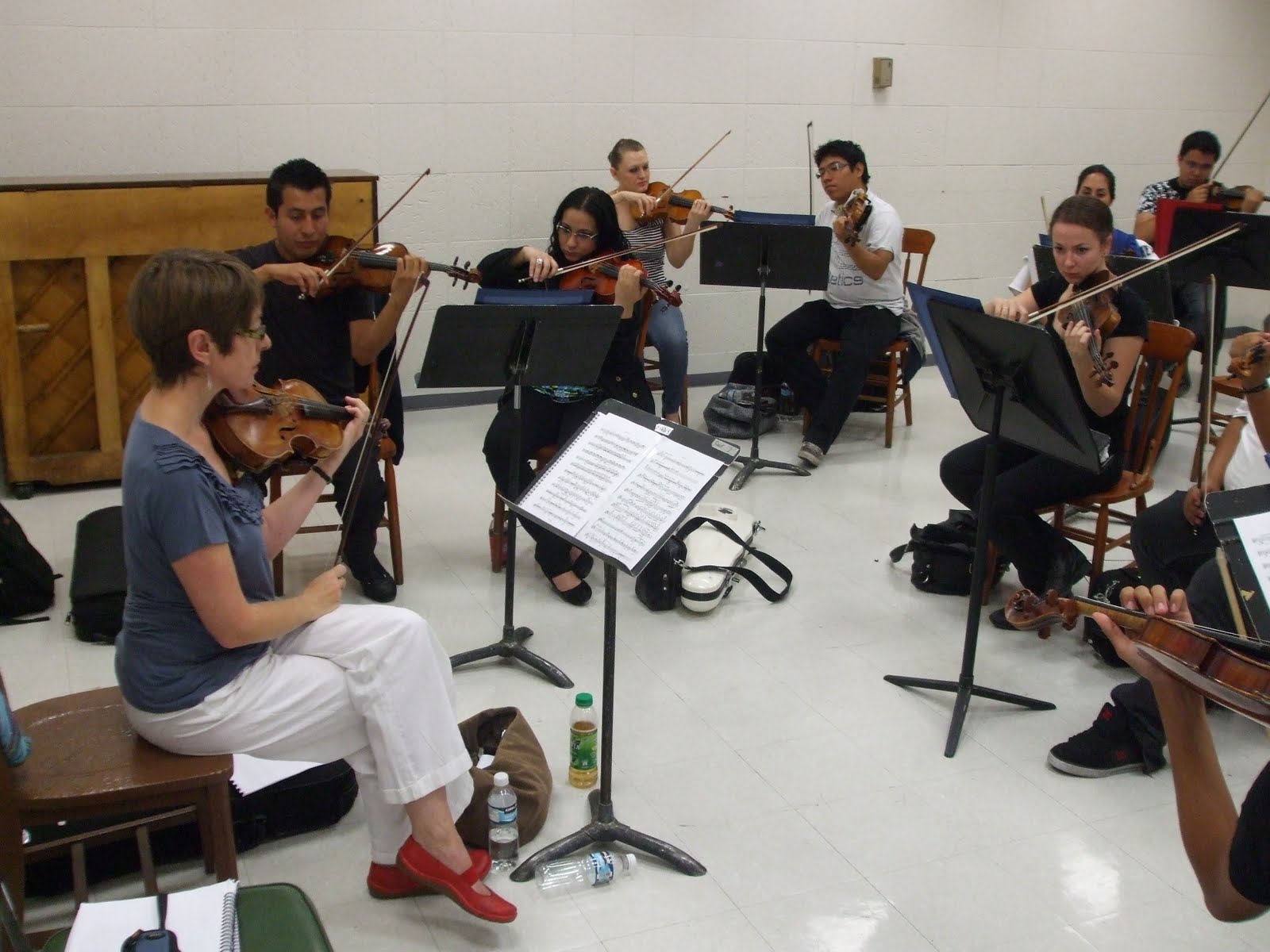
Judith Kelly leading a sectional


Ali Read in the full rehearsal


We've just got back from two extra days in Mexico working with the Carlos Chavez Youth Orchestra. While the rest of the orchestra spent Monday evening at the airport, I [Ali Reid] went with Judith Kelly (violin) and Bridget Carey (viola) to a hotel on the other side of Mexico City to meet with teachers from the youth orchestra.


We had a fascinating discussion hearing about the project which was founded twenty years ago: two orchestras of the best young musicians in Mexico form a school that the students attend daily. Their orchestral work is complemented by individual tuition from some of Mexico's top professionals as well as more wide-ranging lessons including Alexander Technique and movement classes with a dancer. Having told us about their work the teachers were keen to hear about the British system. We also discussed the difficulties facing music education on opposing sides of the world: some problems are the same everywhere, but they have unique challenges to face and were keen to hear our views.


It was inspiring to meet such a fascinating group of teachers together with the visionary Julio at their helm, and it helped to prepare us for the two days ahead.


Early the following morning we departed the hotel for sectionals with the violins and violas. We spent 3 hours with them (and a translator of course!) putting them through their paces with Britten's Sinfonia da Requiem and Tchaikovsky's Fifth Symphony. They were enthusiastic and really receptive: they have two concerts at the end of the week so were keen to work hard together before the afternoon's full rehearsal.


Having finished the morning we all piled onto two buses to go to the full rehearsal - packed lunches on the way! We arrived at a vast complex for the Arts in another part of the city. Not only is it home to a concert hall, but there's also a theatre, art gallery and dance studio just around the corner! This was the first meeting of the orchestra with their conductor for the week (Kenneth Jean) and he played through all of the programme, which also included a new Spanish work. We sat within the sections which was really useful: we could give some help as well as see how things felt in the thick of things!


The following day was a similar pattern of morning sectionals then full rehearsal. I think the three of us found this day even more productive. Having got to know the students and their playing we progressed quickly, and the full rehearsal that afternoon already sounded like a different orchestra. Sadly we had to dash to the airport straight from the hall, so won't have a chance to hear how they change towards the concerts. But we had crammed a lot into two days!


Before leaving we had several good chats with the students, who were also keen to hear all about musical life in England - we will hopefully keep in touch through the wonders of email! They are a really exciting group and the whole project is doing amazing things for the future of classical music in Mexico. An inspiring few days!


Ali Reid


Second Violin with Britten Sinfonia


Our Creative Learning work in Mexico was generously supported by Cambridge University Press, our International Partner.